
Expedition Challenge
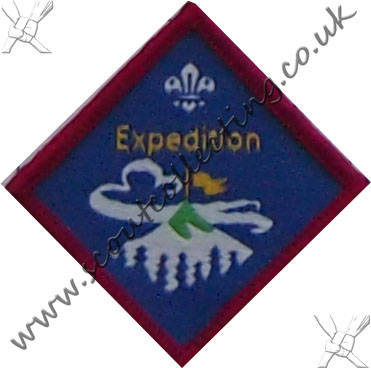
Expedition Challenge Scout Badge post 2002
Challenge Scout badges are worn on the front of the scout
shirt on the Right hand side in line with the membership award.
To earn your Expedition Challenge award a scout must do the
following.
Complete the activities in one
of the following two areas:
Area 1 - Expedition: A journey with a purpose
Take
part in an expedition over two days (including a night away) with at least
three friends. Be involved in the planning of the expedition, complete relevant
training and be properly prepared.
During
the expedition:
a. Play a
full part in the team.
b. Journey
for at least four hours each day.
c.
Use a map to keep track of where you are.
d. Stay
overnight at a hostel or other suitable venue, or camp overnight at a suitable
site.
e.
Cook the evening meal and breakfast.
f.
Achieve at least one goal, agreed with your Leader before the
expedition.
The
expedition may be on foot, canoe, cycle or sailing boat. Other options may be
appropriate, and should be agreed beforehand.
Notes
Scouts
must be supervised taking into account their preparation, training and level of
experience. This may mean that certain legs are 'led' by young people
themselves for information/ project purposes.
As
a minimum, supervision involves a visual check on departure and at the end of
each day, and being in the area of the activity.
The
Scout Association Permit Scheme applies to certain land terrains and
classifications of water. To lead a nights away experience, a young person is
required to hold a nights away event passport.
Area 2 - Exploration: A purpose with a journey
Take part in an exploration over two days
(including a night away) with at least three friends, and report or present
your findings. You must be involved in the planning of the exploration,
complete relevant training and be properly prepared.
You
must have completed some initial research into the subject to be investigated.
The challenge should take place somewhere you have never been before or don't
know well.
During
the exploration:
a. Play a
full part in the team.
b. Travel for
at least 90 minutes to a hostel, campsite or other suitable venue.
c.
Use a map to keep track of where you are.
d. Conduct
the exploration within an agreed area (discussed with a leader in advance)
collecting evidence and information for the report or presentation.
e.
Stay overnight at the venue and cook the evening meal and
breakfast.
f.
Complete the exploration before returning home.
g.
Have the report or presentation ready within four weeks of the
exploration.
The
journey may be on foot, or by public transport, canoe, cycle, aircraft,
wheelchair or boat. Other options may be possible and should be agreed
beforehand.
Notes
The
'exploration' element should last 4-5 hours over the two days. It could be
anything from an investigation into bird life in a wood to visiting museums in
a town.
 More badges...
 Top of page

