
Nautical Skills Advanced
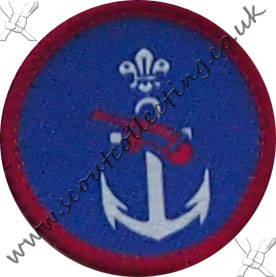
Nautical Skills Advanced Scout Badge post 2002
The Scout Activity badges from post 2002 are
circular with the Activity image on a blue background with a red border. The
Badge is worn on the left sleeve starting from the shoulder and going down in
order of achievement.
To earn the Advanced Nautical Skills Scout badge
they must achieve the following
1.
Develop your skills in one
water-based activity to a level where you can operate safely. This could be
shown through gaining a personal permit or the appropriate National Governing
Body personal competency award.
2.
Demonstrate how to use your craft to
recover others from the water by taking part in a simple rescue exercise.
3.
Demonstrate knowledge of pilotage,
navigation lights, sound signals, tides, currents and eddies, as relevant to
your local waters.
4.
Demonstrate that you can still tie a
figure-of-eight knot, clove hitch, and a round turn and two half-hitches. In
addition tie these three knots: sheet bend, rolling hitch and bowline, and
describe their uses.
5.
Explain the different types of ropes
used in water activities, their advantages and disadvantages, and how to care
for them.
6.
Complete one of the following:
·
Make a rope fender or other piece of
decorative rope work, for example a lanyard or decorative knot.
·
Demonstrate three calls made on a
bosun’s pipe, other than the ‘still’ and ‘carry on’.
·
Hoist the colours for a Sea Scout
Group as part of Sea Scout ceremonial.
7.
With others, plan and take part in a
one-day expedition or exercise afloat.
8.
Know how different boats communicate
with each other, relevant to your location.
9.
Take on the helm or cox role in a
craft or help prepare a team for a competition.
10.
Know how to get local weather
forecasts, understand their importance, and be able to recognise signs of
changing weather.
11.
Know how to safeguard against the
effects of cold. Know how to recognise and treat hypothermia.
 More badges...
 Top of page


